
With over 200 dedicated professionals, Beijing East IP has helped a full spectrum of clients – from startups to Fortune 500 corporations to domestic multinational companies – on their intellectual property issues in China.
Introduction to Partial Design Patent Application
2026-06-08
LIU Chunlei BEIJING EAST IP
The fourth amendment to the Chinese Patent Law in 2021 added partial design to the scope of patent protection, clarifying that “designs mean any new design of the shape, the pattern, or their combination, or the combination of the color with shape or pattern, of a product in whole or in part, which creates an aesthetic appeal and is fit for industrial application”. This change helps promote design innovation in product details, especially in areas where product design is relatively mature and there is limited room for improvement in design.
After nearly three years of examination practice and summary on partial design patent applications, the Implementing Regulations of the Patent Law and the Guidelines for Patent Examination, which came into effect in January 2024, have further refined the rules for partial design patent applications, including specific provisions for relevant examination procedures and standards. The following text provides a brief introduction to the relevant matters.
- What is a Partial Design Eligible for Patent
A partial design is an innovative design directed to a specific part of a complete product. Like ordinary designs, it requires a product as its carrier. The partial design should be able to form a certain independent area on the product and occupy a specific physical space. It can be either a separable part or an inseparable part of the complete product. Visually, a partial design is composed of design units with relatively complete design features.
Chapter 3 of Part I of the Guidelines for Patent Examination explicitly lists two types of partial designs that cannot be granted patent rights:
- Designs that cannot form a certain independent area on the product or constitute a relatively complete design unit. For example, a turning line on a cup handle or an irregular portion arbitrarily cut from eyeglass lens.
- Designs where the part requiring protection is merely a surface pattern or a combination of pattern and color. For example, a pattern on the surface of a motorcycle.
- Product Name and Pictures/Photographs for Partial Design Patent Applications
In addition to meeting the general provisions for design patent applications in Part I of the Guidelines for Patent Examination, partial design patent applications must also satisfy the following special requirements:
Product Name: The product name must clearly specify both the part to be protected and the overall product. It cannot refer solely to the complete product or only to the unprotected part. Examples include “door of a car” or “camera of a phone”.
Pictures/Photographs: Applicants must submit views of the complete product and indicate the content to be protected using a combination of solid and dashed lines or other methods. Parts of the product that do not require protection can be distinguished using dotted lines, semi-transparent filling (wash), or different colors, and should be explained in the brief description.
The following examples illustrate how to distinguish between protected and non-protected parts in the pictures or photographs:
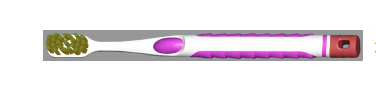
Example 1: In a design patent application titled “Handle of a toothbrush,” the bristle portion, covered with a brownish-yellow semi-transparent wash, is the non-protected part, while the handle is the protected part.
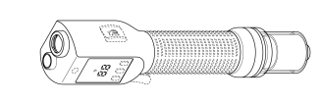
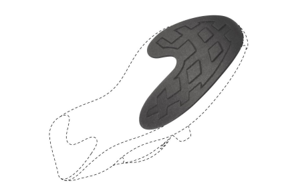
Example 2: In applications titled “Main body of an electric screwdriver handle” and “Front decorative piece of a shoe sole,” solid and dashed lines are used to distinguish the protected parts from the non-protected parts.
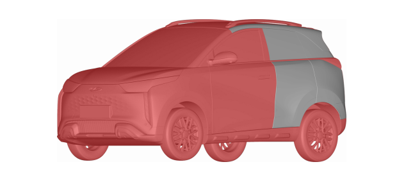
Example 3: In an application titled “Side of an automobile,” different colors distinguish the protected parts from the non-protected parts. The area outside the red coverage is the part protected by the partial design.
III. Post-Filing Amendments and Divisional Applications
After filing a patent application, amendments to a partial design patent application must comply with Article 33 of the Patent Law, just like ordinary design patent applications. This article stipulates that amendments must not exceed the scope shown in the original drawings or photographs. An amendment is considered to be within the allowed scope if the modified content is already shown in the original drawings/photos or can be directly and unambiguously determined therefrom.
In the case of partial design patent applications, regardless of whether the amendment changes a whole design to a partial design, a partial design to a whole design, or one partial design to another within the whole product, the amendment is deemed to be within the allowable scope, provided that the modified content is shown in the original drawings or photographs or can be directly and unambiguously determined therefrom.
It should be noted that, for amendments falling under the above three scenarios, if they are made by the applicant after the expiration of the two-month voluntary amendment period from the filing date as stipulated in Rule 57 of the Implementing Regulations of the Patent Law, such amendments will not be considered as being made in response to the defects pointed out in the Notification of Office Actions, and therefore will not be accepted.
Regarding Divisional Applications:
For the above scenarios, the Guidelines for Patent Examination stipulate:
- If the original application is for the whole design of a product, a part of it cannot be filed as a divisional application.
- If the original application is for a partial design, the whole design or other partial designs cannot be filed as divisional applications.
Under these provisions, whether applicants can achieve the protection of a part of a whole design (or the whole design of a partial design) in a divisional application by first filing the divisional application and then making voluntary amendments remains to be verified in future patent practice.
- Conclusion
The revisions to the Implementing Regulations of the Patent Law and the Guidelines for Patent Examination have refined and improved the application process for partial design patents, providing detailed guidance for applicants and helping to promote further development of design innovation.
Currently, there are no typical or guiding cases involving patent infringement disputes related to partial designs. Under the framework of existing laws, regulations, and judicial interpretations regarding the basic rules for design patent infringement determinations, how to apply the following two factors—the partial use of a partial design and the position and proportion of the partial part in the whole—requires further discussion and summarization in more cases.


-
ABOUT US
-
PRACTICES
-
NEWS & EVENTS
-
Other Links
-
Contact Us
- info@beijingeastip.com
- +86 10 8518 9318
- +86 10 8518 9338
京公网安备 11010102005607号 京ICP备13001631号-1 Copyright ©2002-2023 Beijing East IP Ltd. All Rights Reserved